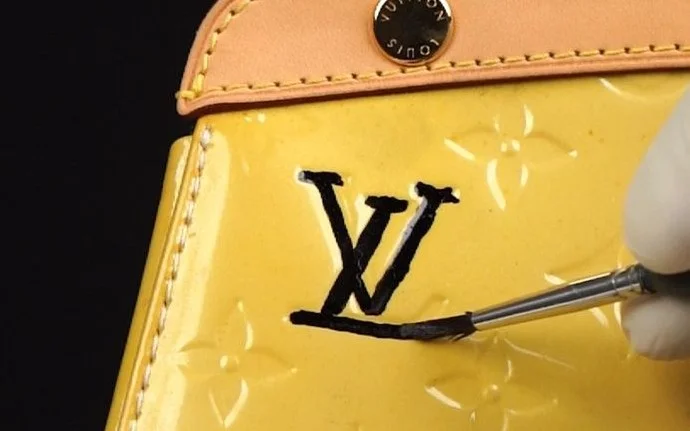
Louis Vuitton's Vachetta leather involves one of the most honest conversations in luxury materials. Unlike the coated "Epi" leathers or the pigment-heavy finishes of modern bags, Vachetta is vegetable-tanned cowhide left largely unfinished. It is designed to be naked. It absorbs the world around it—sunlight, rain, hand oils, and spills.
Over decades, this absorption creates the famous "Patina—a deepening of color from pale beige to honey, and eventually to a rich mahogany. However, patina is rarely uniform. The handles turn black from sweat acidity. The bottom corners dry out and crack. The piping scuffs into grey suede.
When a client brings us a bag described as "ruined," what they usually mean is that the ecosystem of the leather is unbalanced. Our job is not to strip it back to white (which kills the vintage soul) but to stabilize and unify the color. This is the art of Patina Correction.
1. Anatomy of the Patient: The 1995 Keepall 45
Before any chemical touches the bag, we must perform a forensic diagnosis. Vintage Louis Vuitton bags from the 1990s differ significantly from modern production.
Material Composition
- The Canvas: Made of PVC-coated Egyptian cotton. In the 90s, the PVC layer was thicker and more grain-pronounced/pebbled/ textured than today's smoother finish. It is surprisingly durable but prone to hardening.
- The Vachetta: Vegetable-tanned with mimosa and quebracho tree bark. High tannin content means it reacts strongly to iron (turning black) and pH shifts.
- The Hardware: Solid untreated brass. Modern bags use plated zamak. Vintage brass oxidizes to green (verdigris) but can be polished infinitely.
2. The Chemistry of "Dirty" Patina
Why do handles turn black while the tag turns honey? This is Differential Oxidation.
1. UV Radiation (Honey): Sunlight triggers the tannins to rise to the surface,
darkening the leather naturally. This is healthy patina.
2. Lipids & Acids (Black): Human sweat consists of water, salts, lactate,
and
urea. This cocktail is acidic.
When absorbed by the leather, it breaks down the collagen fibers and oxidizes the vegetable tannins
into a dark, greasy pigment.
This is unhealthy patina.
The "Saddle Soap" Mistake
Do not use alkaline cleaners (like Saddle Soap) on blackened Vachetta. The alkalinity reacts with the tannins, permanently "setting" the dark stain deeper into the fiber. You need an acidic-neutralizing approach.
3. The Restoration Protocol: Step-by-Step
Phase 1: Enzyme Extraction (The "Detox")
We begin by applying a paste of specialized enzymes designed to consume organic oils. Unlike solvents which dissolve oil (spreading it further), enzymes break the lipid bonds, allowing the oil to be lifted out of the pore. This process can take 24 to 48 hours of dwelling. The result is "dry" leather—the black grease is gone, leaving behind grey, parched fibers.
Phase 2: Oxalic Chelation
To brighten the grey areas, we use a dilute Oxalic Acid solution. Oxalic acid is a chelating agent—it grabs onto metal ions (like the iron in dust or blood) and strips them away. It also bleaches the organic tannins slightly. Critical: This must be neutralized immediately with a bicarbonate buffer, or the acid will rot the stitching thread.
4. Color Balance: The "Italian" Technique
Now we have a clean bag, but it looks patchy. Some areas are pale (where we scrubbed), others are still dark honey. Standard cobblers would paint over this with heavy acrylic paint, making the bag look like plastic.
We use Translucent Aniline Dyes.
The Triad of Patina
Natural patina is not brown. It is a mix of:
Yellow (Ochre)
Red (Burnt Sienna)
Violet (Trace)
We hand-mix these pigments in a glazing medium that is 90% transparent. We apply this "glaze" in microscopic layers only to the pale areas. Each layer darkens the leather by 5%. We keep building until the pale spot matches the surrounding honey tone perfectly. This creates an "invisible repair" where the grain remains visible.
5. Topcoat Alchemy: Recreating the Sheen
This is the secret sauce. Vintage Vachetta has a very specific "satin" sheen—not matte, not glossy. Modern acrylic varnishes look too wet.
We formulate a Nitrocellulose-Urethane Hybrid Topcoat.
- Nitrocellulose: Provides the silky, warm touch of organic leather.
- Urethane: Provides the flex and scratch resistance of modern engineering.
- Matting Agents: Silica nanoparticles are added to refract light, mimicking the natural dullness of skin.
This mixture is sprayed at high pressure (HVLP) in a dust-free booth. It chemically bonds to the leather, sealing in our color work and creating a hydrophobic barrier that prevents future sweat absorption.
"The goal is restoration, not renovation. When we are finished, the bag should not look new. It should look like a well-loved, 30-year-old bag that has been stored in a time capsule."
— Lead Atelier Technician6. The Hardware Revival
The brass hardware is removed and tumble-polished using walnut shells and jewelers' rouge. Because it is solid brass, we can polish out deep scratches. For the "Louis Vuitton" stamps on the rivets, we use a soft cotton wheel to clean the lettering without softening the crisp edges of the engraving.
7. Future-Proofing Your Vintage
Once restored, a vintage Keepall is ready for another 30 years of travel, provided you follow the "Dry Hands, Dry Air" rule.
- Handle Covers: Consider using silk twillies or crochet handle covers during summer months to prevent direct skin contact.
- Storage: Stuff the bag with acid-free tissue paper to prevent permanent creasing of the canvas.
- Conditioning: Only use wax-free conditioners. Waxes sit on the surface and attract dirt. Use penetrating emulsions.
Do you have a "Project Bag"?
Whether it's a barn-find steamer trunk or your grandmother's Speedy 25, we specialize in the impossible.
Start Your Restoration Journey