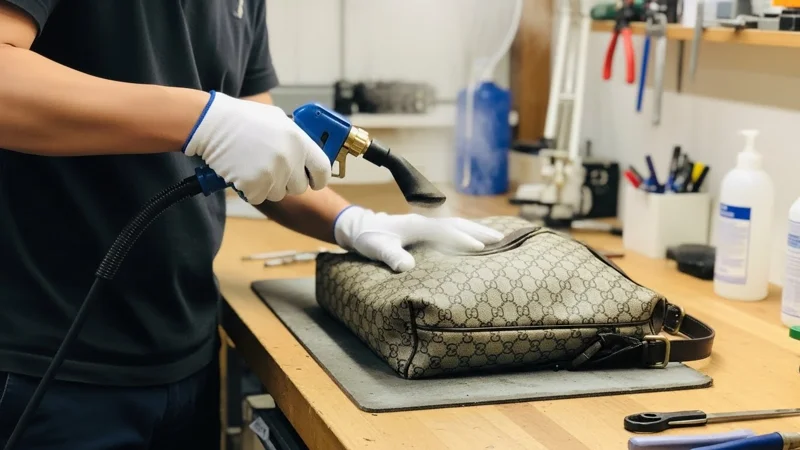
1. The Anatomy of Gucci: Diagnose Before You Doctor
The single biggest mistake luxury owners make is treating their bag as a single object. "I need to clean my bag," they say. But a Gucci bag is not one thing; it is an assembly of conflicting materials. A Gucci Dionysus, for example, is a Frankenstein of texture: it has a coated canvas body (plasticized cotton), suede gussets (open-pore leather), smooth calfskin lining (treated leather), and antiqued brass hardware (patinated metal).
If you use a leather cleaner on the whole bag, you will ruin the suede. If you use a suede eraser on the canvas, you will dull the print. Before you purchase a single tool, you must conduct a forensic audit of your bag.
1.1 The "Big Four" Materials
Most modern Gucci bags fall into four categories. Identify yours:
- GG Supreme Canvas: The beige and ebony print. This is arguably the most durable. It is a woven canvas coated in polyurethane (PU). It feels slightly textured but plastic-like. It is water-resistant.
- Marmont Velvet: Used heavily in the GG Marmont line. This is a plush textile, often silk or cotton-blend, with a distinct "chevron" quilting pattern. It is notoriously fragile and prone to "balding" at high-friction points (like the back of the bag rubbing against jeans).
- Gucci Suede: Found on the Dionysus, Rajah, and Ophidia trims. It offers a rich, matte texture but is a magnet for oils. It absorbs transparent liquids instantly and darkens permanently if not treated correctly.
- Guccissima / Smooth Leather: The "Guccissima" is heat-embossed leather with the GG pattern. The smooth leather (often on the Marmont) is treated calfskin. These are more robust than velvet but less robust than canvas.
2. The Chemistry of Cleaning (And Why Your Kitchen Products Will Destroy Your Bag)
We need to talk about pH. Luxury leather and textiles have a slightly acidic pH (around 4.5 to 5.5). Most household cleaners (dish soap, laundry detergent, magic erasers) are alkaline (pH 8-10). When you apply an alkaline substance to acidic leather, you destabilize the chemical bonds that hold the tanning agents and dyes together. This results in the leather becoming dry, brittle, and eventually cracking.
- Alcohol Wipes / Hand Sanitizer: These are solvents. They strip the PU coating off the GG Canvas, leaving cloudy white smears that cannot be fixed. They melt the finish of Nappa leather.
- Baby Wipes: Often contain moisturizers (bad for suede) and pH balancers for human skin, not cowhide.
- Vinegar: Too acidic. It can "burn" the surface of delicate aniline leathers.
- Magic Erasers (Melamine Foam): This is physically abrasive sandpaper (3000 grit). Using this on coated canvas sands off the protective layer. Using it on leather sands off the dye.
The Professional Toolkit Checklist
To clean like an artisan, you need artisan tools. Do not substitute these.
- Horsehair Brush (High Density): The bristles must be soft enough not to scratch but firm enough to flick dust out of the grain.
- Crepe Suede Brush: A rubbery, gummy brush specifically for lifting the nap of suede.
- Saphir Omni'Nettoyant or similar Suede Shampoo: The gold standard for suede.
- Colloni Carbon Pro or similar Waterproofer: Essential for post-clean protection.
- Distilled Water: Tap water contains chlorine and heavy metals (hard water) which leave microscopic mineral deposits (rings) on fabric.
- White Microfiber Cloths: Never use colored cloths; the dye can bleed onto your bag.
3. Protocol: Cleaning GG Supreme Canvas
GG Supreme is coated canvas, meaning the cotton is sealed under a layer of plastic (polyurethane). This makes it tough, but not invincible. The most common issue is "grime transfer""”stickiness that attracts dirt into the textured grain.
Step 1: The Dry Extraction
Before any liquid touches the bag, you must remove the dry dust. Dust particles naturally settle into the cross-hatch texture of the canvas. If you wet them immediately, they turn into mud and sink deeper.
Take your horsehair brush. Brush the entire bag vigorously in a cross-hatch pattern (left-to-right, then up-and-down). Don't be afraid to apply pressure; canvas loves a good brushing. This flicks the microscopic dust out of the valleys of the grain.
Step 2: The Foam Suspension Technique
We do not "wash" canvas; we lift dirt using foam.
The Mixture: In a bowl, mix 1 part clear, mild dish soap (like Dawn Powerwash,
essentially
pH neutral) with 10 parts distilled water. Agitate it with a whisk until you have a thick, stiff foam"”like
cappuccino froth.
The Application: Dip your microfiber cloth into the foam only. Do not
touch the water. You want the bubbles, not the liquid.
The Scrub: Apply the foam to one panel of the bag. Using a soft-bristled toothbrush
(extra
soft) or the cloth, scrub in small circles. The foam suspends the dirt particles, lifting them away from the PU
coating.
The Wipe: Immediately wipe away the dirty foam with a clean, dry white cloth. Do not let
it
sit.
Step 3: The Rinse (Critical)
Soap residue is sticky. If you leave it on, your bag will attract dirt faster than before. Dampen a clean cloth with pure distilled water (wring it out until it is barely damp) and wipe the bag down twice to remove all surfactant traces. Dry immediately with a towel.
4. Protocol: Restoring Marmont Velvet
The Gucci Marmont in velvet is one of the most beautiful yet heartbreaking bags to own. Owners often complain that the bag looks "bald" or light in color on the front flap and back. This is rarely actual balding; it is crushed pile. The velvet fibers are mashed flat, reflecting light differently and appearing white/worn.
The "Steam Spa" Restoration Technique
To revive the color and fluffiness of the Marmont, you need humidity and heat, but not water.
- Setup: Hang the empty bag by its strap. Stuff it lightly with clean white tissue so the chevron quilting is popped out, not sagging.
- The Steam: Turn on a handheld garment steamer. Let it heat up and spit out the initial water droplets away from the bag. Once you have a steady stream of dry steam, hold the nozzle 6 to 8 inches away from the bag. Never touch the nozzle to the fabric.
- The Pass: Move the steamer slowly over the crushed areas. The steam relaxes the fibers. You will see them start to plump up. Do this for no more than 15-20 seconds per section.
- The Grooming: Immediately put the steamer down. Take a soft-bristled velvet brush (or a brand new, dry, soft toothbrush). Brush the velvet gently against the grain (upwards). This encourages the fibers to stand up straight.
- The Cure: Let the bag air dry in this fluffed state for 24 hours. Do not touch it while damp. When you return, the deep, rich color should be restored.
5. Protocol: The Dionysus Suede Rescue
The Dionysus bag usually features suede on the flap, the pocket under the flap, and the gussets (sides). This is the danger zone. Suede is open-pored and unprotected.
The "Eraser" Technique for Dry Stains
For dark scuffs, transfer marks, or surface dirt:
- Take your white suede eraser (a specialized rubber block).
- Rub the stain gently but firmly. The rubber will crumble"”this is good. It bonds to the surface dirt and lifts it away mechanically.
- Unlike liquid cleaning, this does not push the stain deeper. It is the safest method for novices.
- Once the stain is lifted, use the crepe brush to "re-fluff" the nap in that area so it matches the surrounding texture.
The "Sandpaper" Secret (Expert Level)
If you have a stubborn oil spot or a shiny patch of flattened suede that won't lift with an eraser, professional restorers use a terrifying but effective tool: 600-grit sandpaper.
Gently (very gently) sand the affected area. You are essentially shaving off the microscopic top layer of dirty leather fibers to reveal the fresh, clean leather underneath. Do not do this if you have a "printed" or "foil" suede. This is for traditional napped suede only. Finish by brushing vigorously.
6. Protocol: Guccissima & Smooth Leather
The embossed "Guccissima" leather is prone to dust collecting inside the debossed GG logos, making the bag look dull.
The "Massage" Method
You cannot just wipe Guccissima; you must agitate the pattern.
Step 1: Apply a dime-sized amount of high-quality Leather Cleaner (like Saphir mild
cleaner) to a cloth.
Step 2: Work it into the leather in circular motions.
Step 3: Take your horsehair brush. While the cleaner is on the surface, gently brush the
leather. The bristles will reach into the "valleys" of the GG logo and lift the gray dust that a cloth misses.
Step 4: Wipe dry.
Step 5: Condition. This is crucial for smooth leather. Apply a wax-free conditioner.
Massage it in. Leather is skin; without moisture, it develops micro-cracks (wrinkles) at flex points, especially
on the strap anchor points.
7. The Hardware: Antique vs. Shiny
Gucci hardware confuses people. The Interlocking Gs on the Marmont and the Tiger Head Spur on the Dionysus are typically finished in "Antique Brass."
This means they are supposed to look slightly tarnished, dark in the crevices, and not perfectly
reflective.
The Mistake: Using metal polish (like Brasso or silver polish). These products contain
abrasives that strip the "antique" coating, revealing the bright, cheap-looking base metal underneath. Once you
strip the antique finish, you cannot put it back.
The Fix: Clean Gucci hardware only with a slightly damp microfiber cloth to remove finger oils. If dirt is trapped in the Tiger Head carving, use a Q-tip dipped in soapy water to gently dab it out. Dry immediately to prevent water spots.
8. Interior Restoration: The Pink Satin Nightmare
The pink satin lining of the Marmont series is infamous for showing cosmetic stains (lipstick, foundation, pen
marks).
The Pull-Out Method: Try to pull the lining fabric out of the bag shell as much as
possible. You want to isolate it so that any water you use doesn't soak through to the leather/velvet exterior.
Spot Clean: Use a specialized fabric spot cleaner or a mix of micellar water (makeup
remover). Dab the stain. Do not rub, as satin pills easily.
Ink Leaks: If a pen exploded, stop. Ink migrates. If you wet it, looking to clean a
dime-sized spot, you will wake up to a coaster-sized blue stain. Ink removal on satin requires solvents that
must be flushed out with a vacuum table"”a job for professionals only.
9. Expert Storage: The Long Game
You can clean your bag perfectly, but if you store it wrong, it will die in the closet.
Gravity is the Enemy
The Gucci Dionysus is a "heavy" bag (due to the chain and double flap). If you store it standing up without
stuffing, the front flap will sag, creating a permanent horizontal crease across the face of the bag.
Solution: Stuff the bag firmly with acid-free tissue paper. You want to mimic the shape
of
the bag as if it were full. Ensure the stuffing supports the front flap.
Chain Management
The heavy chains on Gucci bags are dangerous. If you rest the chain on top of the bag for weeks, the metal will
dig into the leather or velvet, leaving permanent dents. In humid climates, the metal can also oxidize and leave
green/black residue on the fabric.
Solution: Tuck the chain straps inside the bag before storing. If they don't
fit,
wrap the chains in a separate soft cloth or bubble wrap so they do not touch the bag's exterior.
The Humidity Factor
In high-humidity regions (like Mumbai or Delhi), PU-coated canvas (GG Supreme) is prone to "hydrolysis." This
is where the humidity chemically breaks down the plastic coating, making it sticky (tacky) to the touch. Once
canvas becomes sticky, it is irreversible.
Solution: Never store bags in plastic boxes. They need to breathe. Use the original
breathable dust bag. Place silica gel packets inside the bag (but wrap them in tissue so they don't touch the
lining directly). Air your bags out in an air-conditioned room once every month.
10. When to Call The Leather Restorators
We believe in empowering owners, but we also believe in knowing when to stop. There are some damages that no amount of home cleaning can fix. In fact, trying to fix them usually makes the professional repair 3x more expensive.
Red Flags: Stop and Call Us
- Color Transfer / Dye Migration: If your raw denim jeans have stained the back of your pink velvet Marmont, this is not "dirt." The indigo dye has chemically bonded with the velvet fibers. Scrubbing will only fade the pink, not remove the blue. We use color-neutralizing enzymes to fix this.
- Exposed Piping: If the leather corners have rubbed through and you can see the plastic tubing inside the piping, no cream will fix this. It requires re-piping (leather surgery).
- Red Rot / Sticky Canvas: As mentioned, if your vintage Gucci feels sticky or is peeling, the material itself has degraded. We can sometimes seal it, but it often requires panel replacement.
- Oil Stains on Suede: If you dropped a slice of pizza on your Dionysus suede, and the cornstarch trick didn't work, do not try soap. You will create a "tide line" (water ring). We have degreasing immersion tanks for this specific problem.
Is Your Gucci Beyond DIY Help?
Some stories need a ghostwriter. Let our master artisans rewrite the history of your damaged bag with museum-grade restoration.