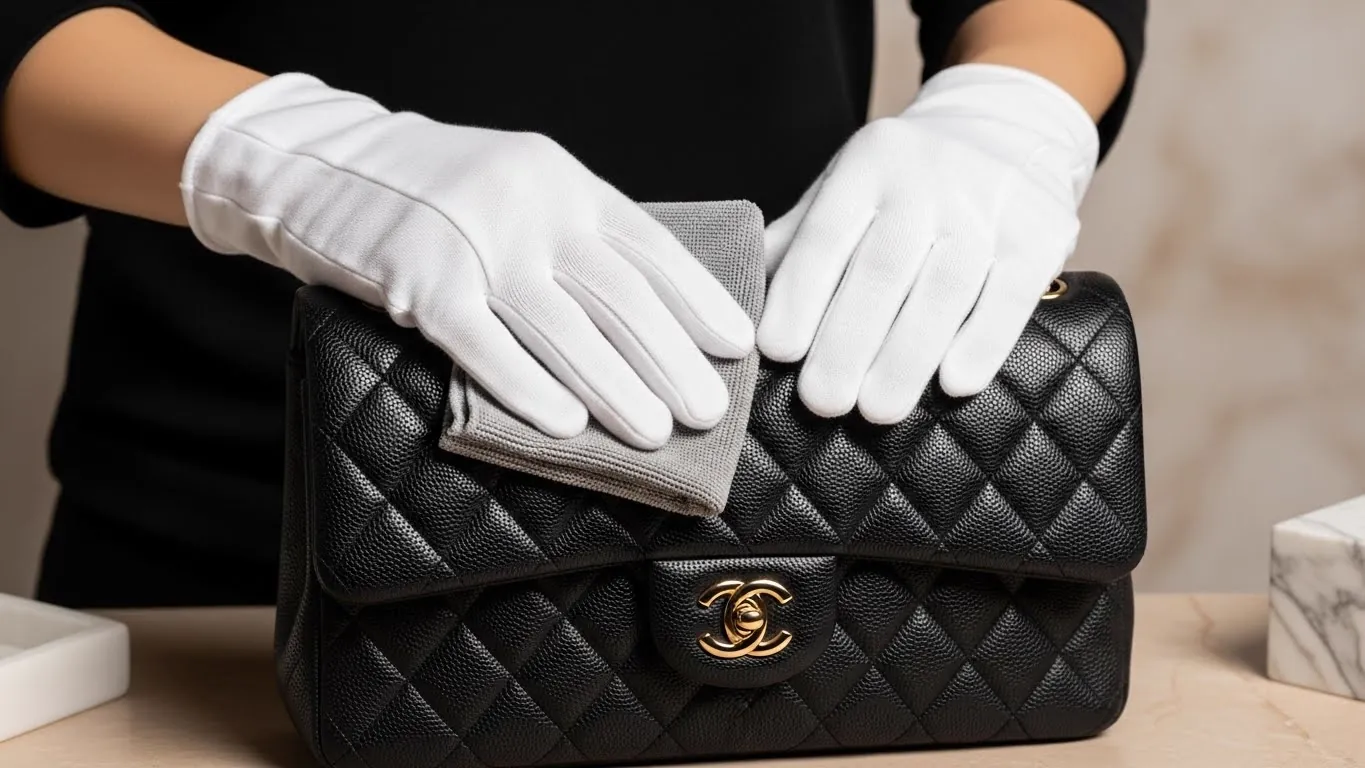
1. Diagnosis: Decoding the Chanel Leather Library
The single biggest mistake luxury owners make is treating their bag as a single object. "I need to clean my bag," they say. But a Chanel bag is not one thing; it is an assembly of conflicting materials. A Chanel Boy Bag, for example, often combines a rigid calfskin frame with a delicate velvet center and ruthenium hardware. If you use a leather cleaner on the whole bag, you will ruin the velvet. If you use water on the lambskin, you will stain it. Before you purchase a single tool, you must conduct a forensic audit of your bag.
1.1 Caviar Leather (Grained Calfskin)
This is the armor of the Chanel world. It is made from calfskin with a heavy, pebbled grain embossed onto
the surface. It feels bumpy, rigid, and durable.
The Finish: It often has a slight semi-gloss coating that repels water.
Vulnerability: While tough, the "pebbles" act like a trap. Dust settles in the
valleys between the grain, turning grey bags dull and black bags ashy.
1.2 Lambskin (Smooth Agneau)
The porcelain of leathers. It is incredibly soft, buttery smooth to the touch, and has a flat, fine grain
with a subtle natural sheen.
The Finish: Minimally treated. This means the pores are open.
Vulnerability: Everything. It scratches if you look at it wrong. It absorbs hand
oils (darkening the handles) and water spots instantly. It also "deflates""”the puffiness of the quilts
relies on the leather's tension, which relaxes over time.
1.3 Aged Calfskin (Reissue 2.55)
Used primarily on the 2.55 Reissue, this leather is pre-distressed. It looks wrinkly and feels
unstructured.
The Finish: It is tougher than lambskin but softer than Caviar. It hides
scratches
well because it is already meant to look worn.
Vulnerability: Structure loss. Because it is soft, it collapses easily if not
stuffed.
1.4 The Exotics & Fabrics
- Tweed: A coarse woolen fabric. It is a magnet for dust and pulls/snags easily.
- Velvet: Plush and luxurious, but prone to "balding" at the corners due to friction.
- Patent: High-gloss leather sealed in plastic. Notorious for "dye transfer" (absorbing color from other items).
2. The Chemistry of Clean (Don't Ruin Your Investment)
We need to talk about pH. Chanel leather has a slightly acidic pH (4.5-5.5). Most household cleaners are alkaline (pH 8-10). Using dish soap or magic erasers destabilizes the leather's chemistry, leading to dry rot years down the line.
- Magic Erasers: This is abrasive sandpaper. It removes the topcoat of Caviar and the dye of Lambskin.
- Alcohol/Sanitizer: It strips natural oils instantly, leaving a white, bleached spot.
- Saddle Soap: Too harsh and alkaline for delicate French handbags. It's meant for horse saddles, not Haute Couture.
3. Protocol: The Caviar Deep Clean
Caviar is forgiving, but it loves to hold onto grime. The goal is extraction without abrasion.
Step 1: The Dry Excavation
Dust is sharp. If you rub a dusty bag, you are sanding it. Take a soft horsehair brush
(like those used for polishing shoes, but brand new). Brush the bag vigorously in circular motions.
Focus: Dig into the crevices of the CC logo and the chain strap holes.
Step 2: The Foam Suspension
We don't wet the leather; we use foam to lift dirt.
Mix: 1 part gentle leather cleaner (like Collonil diluted) to 10 parts distilled
water in a foaming bottle.
Apply: Pump the foam onto a white microfiber cloth. Do NOT apply directly to the
bag.
Scrub: Gently massage the Caviar. The foam lifts the dirt from the "valleys" of
the
grain.
Wipe: Immediately wipe with a dry cloth to remove the dirty foam.
Step 3: The Gloss Restoration
Caviar can look matte if dry. Apply a very small amount of Collonil 1909 Supreme Creme. It creates a breathable barrier that restores the semi-gloss finish and repels water.
4. Protocol: The Lambskin Surgery
Lambskin requires a surgeon's touch. Do not use water. Water causes the leather fibers to swell and create permanent bumps.
The "Finger Buffing" Technique
Most scratches on lambskin are not cuts; they are displaced oils.
The Fix: Wash your hands thoroughly and dry them. Using the pad of your clean
finger, rub the scratch in a circular motion. The natural oils from your skin combined with the friction
heat will often massage the scratch away.
The "Chamois" Polish
For dull lambskin, use a clean Chamois cloth (natural leather cloth). The texture of the chamois against the lambskin acts as a micro-polisher, bringing back the natural sheen without any chemical products.
5. Protocol: Tweed, Velvet & Aged Calfskin
Cleaning Chanel Tweed
Tweed is a textile. It traps dust deep in the weave.
- Vacuum: Use a specialized micro-vacuum attachment (or put a stocking over your vacuum hose) to suck out dust.
- Spot Clean: If there is a stain, dab (do not rub) with a mixture of micellar water (oil-free makeup remover) and water. Rubbing frays the wool.
- Pilling: Use an electric fabric shaver very gently to remove fuzz balls.
Reviving Chanel Velvet
Velvet looks flat because the fibers are crushed.
- Steam: Hold a steamer 6 inches away from the bag. Let the steam penetrate the fibers (do not get it wet).
- Brush: While warm, use a soft baby brush to brush the pile in the opposite direction. This stands the fibers up and restores the color depth.
Aged Calfskin (2.55 Reissue)
This leather is robust. You can clean it similarly to Caviar, but be gentle. The "wrinkles" are intentional; do not try to buff them out.
6. The Emergency Room: Specific Stain Removal
Denim Transfer (The Blue Death)
If your light beige bag has blue stains on the back from your jeans, this is dye migration.
The Truth: You cannot fix this at home. The blue dye has bonded with the leather
dye. Alcohol will remove both, leaving a white patch. This requires professional color correction
(repainting).
Oil / Grease Stains
If you dropped salad dressing or hand lotion on the bag.
Immediate Action: Cover the spot with cornstarch or talcum
powder.
Let it sit for 24 hours. The powder will absorb the oil from the leather pores. Brush it off. Repeat if
necessary. Do not rub with water; water and oil don't mix.
Mold / Mildew
Common in humid climates (like India). It looks like white powder or smells musty.
The Fix: Kill the spore first. cleaning visible mold is not enough. You need UV
treatment or Ozone treatment. wiping it with vinegar is risky on Chanel leather. Call a professional.
7. Hardware Care: 24k vs. Champagne vs. Ruthenium
Identify your hardware to treat it right.
- Vintage Gold (Pre-2008): Plated in real 24k gold. Deep yellow. Can be polished gently with a jeweler's cloth.
- Champagne Gold (Modern): A lighter, cooler gold tone. The plating is thinner. Do not polish aggressively.
- Ruthenium (Gunmetal): Intentionally distressed usage. Low maintenance.
The Green Gunk: If you see green residue around the chain holes, that is oxidation (verdigris). Use a toothpick to gently scrape it out. Do not let it sit, as it eats into the leather.
8. Expert Storage: The Chain Protocol
The number one killer of Chanel bags in storage is the chain strap.
Method 1: Tuck the entire chain inside the bag. Make sure there is tissue paper between the chain and the interior lining so it doesn't scratch the inside.
Method 2: Wrap the chain in felt or tissue paper if it must be outside.
Stuffing: Chanel bags collapse. Stuff them firmly with acid-free tissue paper to support the "structure" of the base. Store upright in the dust bag. Never in plastic.
9. When to Call The Leather Restorators
We specialize in the "impossible" fixes for Chanel:
- Quilt Re-Puffing: We can surgically inject padding to restore flattened quilts.
- Re-Plating: We can dip your faded hardware in 24k gold to restore the vintage shine.
- Corner Restoration: We use liquid leather fillers and color matching to rebuild worn corners.
- Structure Reinforcement: If your bag is "slouching," we insert internal stiffeners.
Is Your Chanel Losing Its Luster?
From vintage 2.55s to modern Boys, we restore the legacy of your handbag.