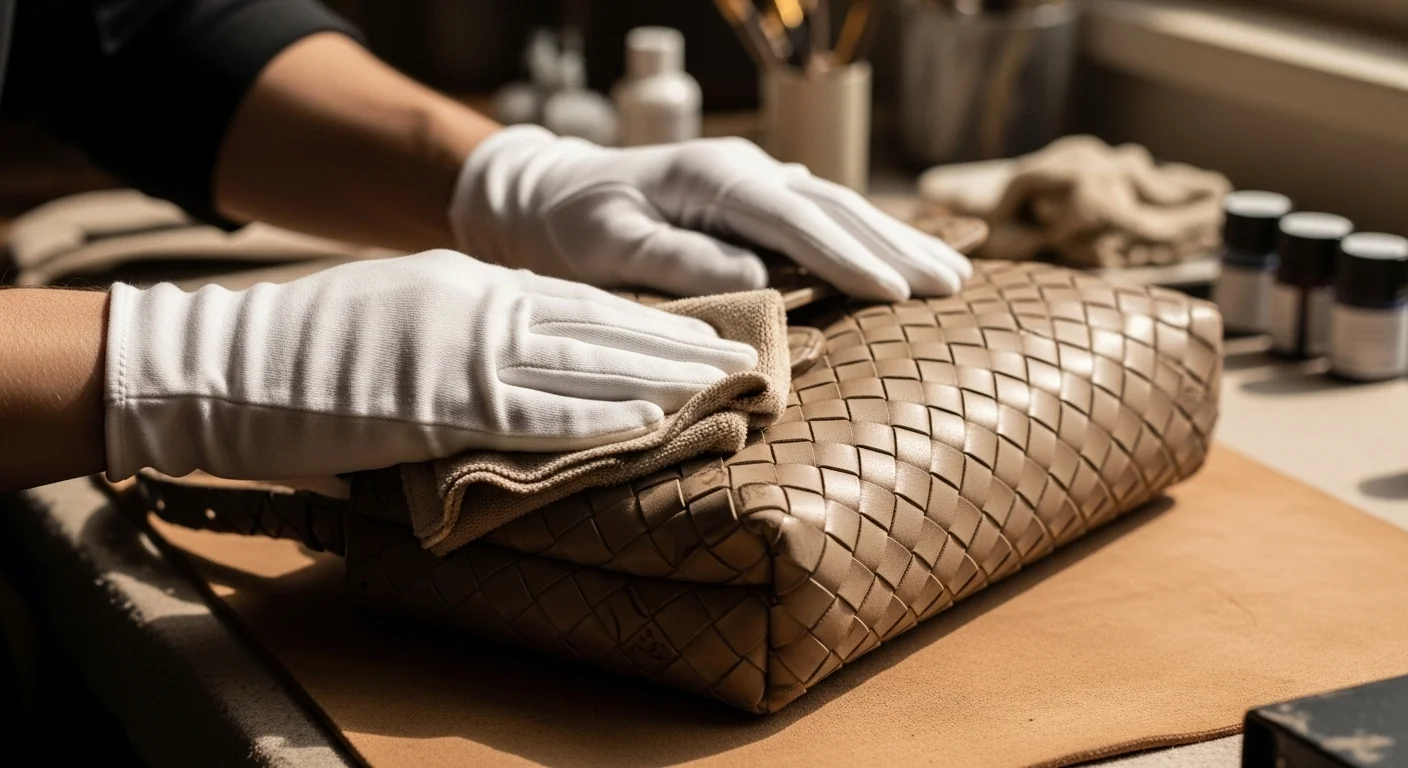
The Philosophy of Bottega Veneta Care
Owning a Bottega Veneta is owning a piece of Italian history. Famous for its "stealth wealth" aesthetic, the brand rarely uses logos. Instead, it relies on the iconic Intrecciato weave and the supreme quality of its leather to make a statement. This understated luxury requires a specific maintenance philosophy: less is more.
Unlike structured bags that can withstand a bit of scrubbing, Bottega bags (like the Pouch, the Cassette, or the Jodie) are often soft, slouchy, and incredibly tactile. Aggressive cleaning can flatten the weave, create color discrepancies, and dry out the Nappa leather. This guide is designed to help you maintain that "fresh from the boutique" feel using safe, proven techniques.
1. Bottega Veneta Heritage: Why Precision Matters
1.1 The Science of the Weave: The Friction Model
In mechanical terms, the Intrecciato weave is a multi-axial friction surface. Every time the bag moves, the individual leather strips rub against each other. When microscopic dust particles (silica) enter these gaps, they act as an abrasive. Professional cleaning isn't just about the surface; it's about lubricating the grid. This is why hydration is more important for Bottega than for almost any other brand. Without moisture, the friction increases, and the leather "dusts" itself from the inside out.
To truly understand how to clean your bag, you must understand its construction. Founded in Vicenza, Italy, in 1966, Bottega Veneta developed the Intrecciato technique out of necessity. The sewing machines available in the workshops of the Veneto region were originally designed for clothing, not thick leather luggage. To work around this, artisans cut fine leather into thin strips (fettuccine) and wove them together to create a material that was strong yet incredibly supple.
This history is crucial because it explains the vulnerability of your bag. It is not a single slab of leather; it is a complex grid of interconnected strips. Dirt, dust, and moisture do not just sit on the surface"”they get trapped inside the weave. This friction acts like sandpaper, slowly eroding the edges of the leather strips over time, leading to that dreaded "frayed" look seen on poorly maintained vintage pieces.
Preserving a Bottega Veneta bag is about preserving this structural integrity. It requires a regimen of gentle extraction, hydration, and protection that differs significantly from how you would treat a rigid Louis Vuitton canvas or a thick Hermès Togo leather.
2. Know Your Leather: The Foundation of Care
Before you touch your bag with any product, you must identify the material. Bottega Veneta uses several premium leathers, and treating them incorrectly can be disastrous:
2.1 Nappa Leather (The Classic)
This is the brand's signature. Derived from lambskin, it is famous for its buttery softness and smooth, semi-aniline finish. It is incredibly delicate, porous, and prone to scratches. It absorbs oils (from hands) and water instantly. Cleaning Nappa requires extreme caution because aggressive rubbing can strip the dye or leave a permanent dark spot. If your bag feels like silk, it is likely Nappa.
2.2 Calfskin (The Workhorse)
Often found on newer, shinier models like the padded Cassette or men's briefcases, calfskin is more durable than Nappa. It has a tighter grain and is often treated with a light protective coating that gives it a subtle sheen. While more resistant to scratches, it is prone to "creasing" if stored improperly.
2.3 Suede and Nubuck (The Delicate)
Found on models like the Velvet Cassette or lining of clutches. These materials have a "nap" (raised texture) that can be ruined by water. They act like sponges for liquid stains. Suede requires dry cleaning methods exclusively"”never let water touch a suede Bottega.
2.4 Exotic Leathers (The Investment)
Bottega is renowned for its Crocodile, Python, and Ostrich bags. These are hydro-reactive. A single drop of water can leave a permanent blister on reptile skin. Do not attempt DIY cleaning on exotic leathers. These require professional glazing and conditioning.
3. The Essential Toolkit (What to Buy & What to Avoid)
You cannot clean a luxury bag with household supplies. The pH balance of dish soap or vinegar ruin the protein structure of fine leather. Here is your shopping list for a safe home spa day:
- Soft Horsehair Brush: Essential for the Intrecciato weave. The bristles are soft enough not to scratch Nappa but firm enough to flick dust out of the crevices.
- Premium Microfiber Cloths: Buy white ones to ensure no dye transfer occurs. You need at least three: one for cleaning, one for drying, and one for buffing.
- pH-Neutral Leather Cleaner: Look for a foam-based cleaner specifically labeled for "Aniline" or "Nappa" leather. Brands like Collonil or Saphir are gold standards.
- Leather Conditioner (Wax-Free): Avoid heavy waxes that leave a white residue in the weave. You need a lotion-consistency conditioner that penetrates deep.
- Cornstarch or Talcum Powder: For oil stain emergencies.
- Distilled Water: Tap water contains chlorine and minerals that can leave ring marks.
4. The Pre-Cleaning Ritual
Proper preparation is half the battle. Never rush this step.
4.1 The Patch Test (Golden Rule)
Before applying any cleaner or conditioner, test it on a tiny, hidden area. The interior facing of a strap or the bottom corner is ideal. Apply a tiny dot, let it dry for 24 hours. If the color changes, becomes sticky, or hardens, do not use it.
4.2 Empty & Shake
Turn the bag upside down and gently shake it. You want to dislodge crumbs, coins, and debris from the interior corners. Use a lint roller on the lining to pick up dust.
4.3 Dusting the Weave
This is the most satisfying step. Take your horsehair brush and gently brush the entire exterior. Use short, flicking motions. Follow the direction of the weave (usually diagonal). You are trying to lift the microscopic dust that settles in the overlaps of the leather strips. If this dust stays, it attracts moisture and turns into grime.
5. Surface Cleaning: The Gentle Wipe Down
For Nappa and smooth leathers, your goal is to remove surface oils and environmental film without soaking the hide. Remember: leather is skin. You wouldn't scrub your face with a Brillo pad.
The Foam Method:
- Pump a small amount of leather cleaning foam onto your microfiber cloth. Never apply cleaner directly to the bag, as it can create a concentrated spot.
- Gently massage the cloth to distribute the foam. It should be slightly damp, not wet.
- Begin wiping the bag in gentle, circular motions. Start at the bottom and work your way up.
- For Intrecciato: Be extra careful. Wipe with the grain of the weave. Do not scrub back and forth aggressively, or you risk lifting the edges of the leather strips, which causes them to curl.
- Work in sections. Clean one panel, then immediately wipe it dry with a fresh, dry cloth. Do not let the cleaner sit on the surface effectively.
- Inspect the cloth. You might see a little dirt coming off. If you see the color of the bag coming off (dye transfer), stop immediately.
6. Advanced Stain Removal (The Surgery)
Stains on Nappa leather are terrifying, but manageable if you act fast. Here is how to handle the most common disasters.
6.1 Oil and Grease (Hand Lotion, Food, Sebum)
The handles of Bottega bags often darken due to hand oils.
The Fix: Blot the excess oil immediately with a dry paper towel. Do not rub! Sprinkle a
mound of cornstarch or baby powder (talc) directly onto the stain. Let it sit overnight (24 hours). The powder
acts as a poultice, drawing the oil out of the pores. In the morning, gently brush the powder away. Repeat if
necessary. This is the safest method for Nappa.
6.2 Ink Marks
Ink penetrates deep into the fibers of Nappa leather.
The Fix: Use a specialized leather ink remover stick. Dab it precisely on the ink mark.
Do
not spread it to the surrounding clean leather. Let it lift the ink, then blot. Warning: If the
ink doesn't move after one or two tries, stop. Aggressive removal will strip the bag's finish, leaving a bald
spot that looks worse than the pen mark.
6.3 Denim Dye Transfer
This happens when dark jeans rub against a light-colored bag (like a beige Padded Cassette).
The Fix: Use a high-quality leather cleaner immediately. The longer the dye sits, the
deeper it migrates. If a standard cleaner doesn't work, this is a chemical reaction that requires professional
color restoration.
6.4 Water Spots
If you get caught in the rain, your bag may develop dark ring marks.
The Fix: It sounds counterintuitive, but you need to dampen the entire area slightly
(edge
to edge) with distilled water to remove the "water line." As it dries evenly, the ring should disappear. Allow
it to dry naturally away from heat.
7. Conditioning: The Fountain of Youth
Leather loses moisture over time, just like human skin. If you don't replenish it, the intricate folds of the Intrecciato weave will become brittle and crack. A well-conditioned bag is also more resistant to future stains.
The Protocol:
- Choose a premium conditioner (like Saphir Renovateur Nappa or Collonil 1909).
- Apply a pea-sized amount to a soft cloth. Rub the cloth together to emulsify the conditioner.
- Gently massage it into the bag. The massaging action generates slight warmth, which helps the pores open and absorb the oils.
- Crevice Care: Ensure you are not leaving white globs of conditioner inside the weave holes. Buff meticulously with a dry brush afterwards to clear the intricate gaps.
- Let it rest for at least 1 hour (preferably overnight) before buffering with a clean cloth to bring out a natural satin glow.
8. Model-Specific Care Guide
Different Bottega icons have different weak points. Here is how to troubleshoot specific models.
The Pouch (The Cloud)
The Issue: Structure loss and scuffed corners. The Pouch is unstructured, meaning gravity
pulls it down, causing the bottom corners to rub against surfaces constantly.
The Care: Always store stuffed. When cleaning, pay extra attention to the magnetic frame
closure"”wipe the leather covering the magnets gently to prevent oils from your hands degrading the leather at
the opening point.
The Cassette / Padded Cassette
The Issue: Puff deflation and edge wear. The "puff" is created by foam padding inside the
double-face Nappa strips.
The Care: Do not crush this bag in storage. The foam can lose its memory. When cleaning,
do
not press down hard on the padded strips, or you risk wrinkling the leather permanently. Clean the edges of the
strips where they overlap, as dust loves to hide there.
The Jodie
The Issue: Handle darkening. The Jodie is carried by hand or in the crook of the arm, leading
to heavy oil buildup on the knot and handle.
The Care: Wipe the handle down after every use with a dry cloth. Use the
cornstarch method monthly to extract oils before they turn the leather black.
The Cabat
The Issue: Unlined delicacy. The Cabat is woven from double-faced leather and has no lining.
This means the interior is just as delicate as the exterior.
The Care: Use a bag organizer to protect the interior floor from pen marks and spills.
When
cleaning the exterior, support the bag from the inside with your hand so you aren't pushing the weave inwards.
9. The Interior: Don't Forget the Inside
Bottega interiors are often lined with suede, unlined leather, or light canvas. A dirty interior lowers resale value significantly.
- Suede Lining: This is a magnet for dust. Use a vacuum with a clean, small nozzle attachment to suck out dust from the corners. Use a suede eraser block to lift dark friction marks.
- Leather Lining: Wipe with a damp cloth as you did the exterior.
- Odors: Never spray perfume directly on the bag; the alcohol can spot the leather. If the bag smells musty, place a container of baking soda (fridge pack) or an activated charcoal bag inside the purse. Place the purse in its dust bag and leave it for 48 hours. The charcoal absorbs the odor molecules.
10. Storage: The Silent Killer
How you store your bag is just as important as how you clean it. Improper storage causes mold, permanent creases, and oxidation.
The Humidity Battle (India Specific)
In humid climates like Delhi, Mumbai, or tropical regions, leather is prone to mold.
The Protocol: Never store bags in plastic bins or plastic bags; they trap moisture. Use
the
original flannel dust bag (which is breathable). Place silica gel packets inside the bag, but do
not let them touch the leather directly (they can chemically burn it). Wrap them in a tissue first.
Air your bags out once a month in an AC room.
Stuffing is Key
Bottega bags are unstructured. If you leave a Pouch empty on a shelf, it will collapse into a puddle of wrinkles. Stuff it with acid-free tissue paper or a custom-made pillow. Do not overstuff; you want to support the natural shape, not stretch it like a balloon.
Chain Management
If you have a chain Pouch or Cassette, never leave the metal chain resting on the leather exterior. The weight of the chain will leave permanent indentations, and the metal can react with the tanning agents to leave black marks. Tuck the chain inside the bag, wrapping it in a soft cloth.
11. Authenticity & Quality: What Cleaning Reveals
Cleaning is a great time to inspect your bag. High-quality Bottega Veneta bags have specific "tells."
The Smell: It should smell like rich, earthy leather, not chemicals or plastic.
The Weave: The strips should be uniform. In counterfeits, the cleaning process might
cause
the "leather" to peel or bubble, revealing it as synthetic.
The Edges: Authentic Bottega strips are often raw-edged or very finely glazed. If you see
thick, rubbery piping that peels off during cleaning, it's a red flag.
12. When to Call the Professionals
DIY care is for maintenance. It is not for surgery. There are lines you should not cross. If your bag has significant color fade (sun damage), deep liquid stains (wine, oil that won't lift), or structural damage (torn weave), do not try to fix it at home. You will make it worse.
At The Leather Restorators, we specialize in the complex restoration of Bottega Veneta Intrecciato. Our atelier offers:
- Color Restoration: We custom-mix pigments to match the unique, complex shades of Bottega archives (like the specific 'Parakeet Green' or vintage burgundy).
- Edging Repair: Re-sealing the thousands of micro-edges in a fraying Intrecciato weave using flexible edge coat.
- Ozone Treatment: For mold removal and odor neutralization that goes deep into the fibers.
- Hardware Plating: Restoring the luster to scratched gold or silver finishings.
Is Your Bottega Bag in Need of Rescue?
Don't risk your investment. Let our master artisans restore its glory with museum-grade care.
13. Final Thoughts
Your Bottega Veneta is a companion for life. It is designed to soften, to age, and to travel with you. It doesn't need to look perfect; it needs to look loved. By following this 2026 expert guide, you ensure that every weave, stitch, and fold remains healthy, resilient, and beautiful. Treat it with the respect it deserves, and it will remain a symbol of quiet luxury for generations.
Remember: When in doubt, do less. And when the problem is big, call the experts.
14. Indian Subcontinent Strategy: Monsoon & Summer Care
In regions like the Delhi NCR or Mumbai, the climate is an extreme enemy of Nappa leather. During the Summer, the high dry heat (45°C+) sucks the fat-liquors out of the leather, making it feel like cardboard. During the Monsoon, the 90%+ humidity triggers mold inside the weave gaps within 48 hours.
- The AC Rule: Never store your Bottega in a room that isn't climate-controlled. If you feel hot, your bag is drying out.
- The Dehumidifier: If you have a collection of more than 3 Bottega bags, a dedicated dehumidifier set to 45% is the best investment you can make.
15. The Comparison: DIY vs. Professional Restoration
| Task | Home (DIY) | Atelier (Professional) |
|---|---|---|
| Dusting | Surface brushing with horsehair. | Ultrasonic vacuum extraction of deep grit. |
| Hydration | Top-layer conditioning cream. | Steam-infused deep protein hydration. |
| Stain Removal | Cornstarch (Oil) or blotting. | Micro-solvent extraction & re-dyeing. |
| Fraying | Not Recommended. | Thermal binding & Edge-paint reconstruction. |