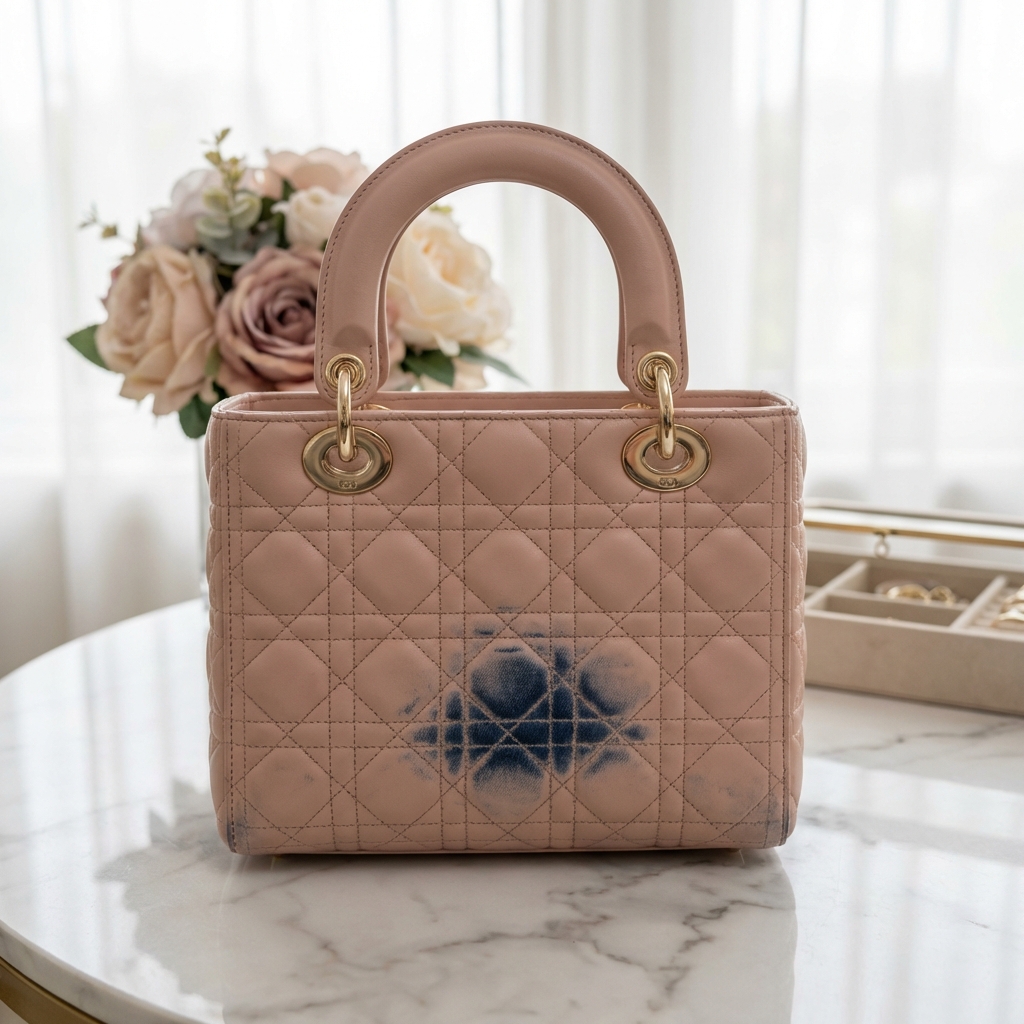
It happens in slow motion. You spent the day in your favorite new black denim jeans, carrying your pristine Powder Pink or Cloud Blue Lady Dior. You arrive home, set the bag down, and your heart stops. A faint, bruised blue shadow has migrated across the back panel of the bag. This is color transfer, and it is the single most common cause of panic among luxury handbag owners.
Of all the cosmetic damages we treat at The Leather Restorators, color transfer—specifically from dark denim—is the most insidious. It is not surface dirt. It is a chemical migration where the dye from your clothes physically penetrates the finish of your bag.
The bad news: It is difficult to remove. The good news: It is not impossible, provided you act immediately and, more importantly, do not make the mistake of scrubbing it deeper into the grain.
Common internet advice will tell you to use nail polish remover or magic erasers instantly. If you have a Patent Leather or Lambskin Dior, this can permanently strip the finish, turning a $500 repair into irreparable damage. Read this guide before you touch your bag.
1. Understanding the Enemy: What is Color Transfer?
Color transfer, or dye migration, occurs when unstable dyes from textiles (usually denim, but also dark cottons or wools) rub against the leather of your bag. This is exacerbated by three factors:
- Friction: The constant rubbing of the bag against your hip creates heat and abrasion, opening the pores of the leather.
- Moisture: Humidity, sweat, or even rain acts as a bridge, carrying the dye molecules from the fabric into the leather.
- Leather Porosity: Dior's signature Lambskin (Agneau) is incredibly soft and absorbent. Unlike the coated canvas of Louis Vuitton, treated lambskin drinks up foreign substances.
2. The "Golden Hour": First 24 Hours Response
The clock is ticking. Dye does not sit on the surface forever; it slowly bonds with the leather fibers. If you catch the stain within the first hour, your chances of 100% removal are high. If you wait a week, the dye sets.
What To Do Immediately
If you are out and notice the stain:
- Isolate the bag: Stop carrying it against your body immediately. Hold it by the top handles away from your jeans.
- Dry Blotting: Take a clean, dry white tissue and gently blot (do not rub) the area to pull up any surface dye that hasn't set.
- Baby Wipe (Emergency Only): If you have an alcohol-free, fragrance-free baby wipe (like WaterWipes), you can do a single, gentle swipe. If color comes up, great. If not, STOP. Do not scrub.
3. Dior-Specific Material Guide
Not all Dior bags are created equal. The treatment for a Lady Dior in patent leather is radically different from one in matte lambskin. Identify your material before proceeding.
A. Cannage Lambskin (The Standard)
This is the classic, puffy, buttery-soft leather of the Lady Dior. It is porous and delicate.
Risk Level: High.
Repairability: Moderate. Lambskin can be cleaned, but aggressive scrubbing will
flatten the "puffs" of the quilting.
B. Patent Leather (Vernis)
High-gloss, glass-like finish.
Risk Level: Critical.
Repairability: Low to Impossible. Patent leather absorbs dye into the urethane
coating. Once it penetrates, it is trapped under the "glass." Surface cleaning rarely works; often
the leather must be stripped and recoated professionally.
C. Grained Calfskin (Diorama/Book Tote)
Textured, durable leather.
Risk Level: Moderate.
Repairability: High. The pigment sits on top of the grain, making it easier to
lift without damaging the structure.
D. Oblique Jacquard Canvas
Fabric material.
Risk Level: Moderate.
Repairability: High. Fabric cleaning involves shampooing and extraction, which
is generally very effective for dye transfer.
"The biggest mistake clients make is trying to scrub a Patent Leather Lady Dior. You cannot scrub dye out of plastic; you will only cloud the shine. Patent transfer is permanent without professional chemical intervention."
— Lead Technician, The Leather Restorators4. DIY Removal Protocols (The Safe Zone)
If the stain is fresh (less than 24 hours old) and on **Lambskin or Grained Leather**, you can try these safe home methods. Proceed at your own risk. Always test in an invisible spot first.
Method 1: The Specialized Leather Cleaner
You will need:
- A premium leather cleaner (e.g., Collonil Carbon Lab, Apple Brand, or Saphir).
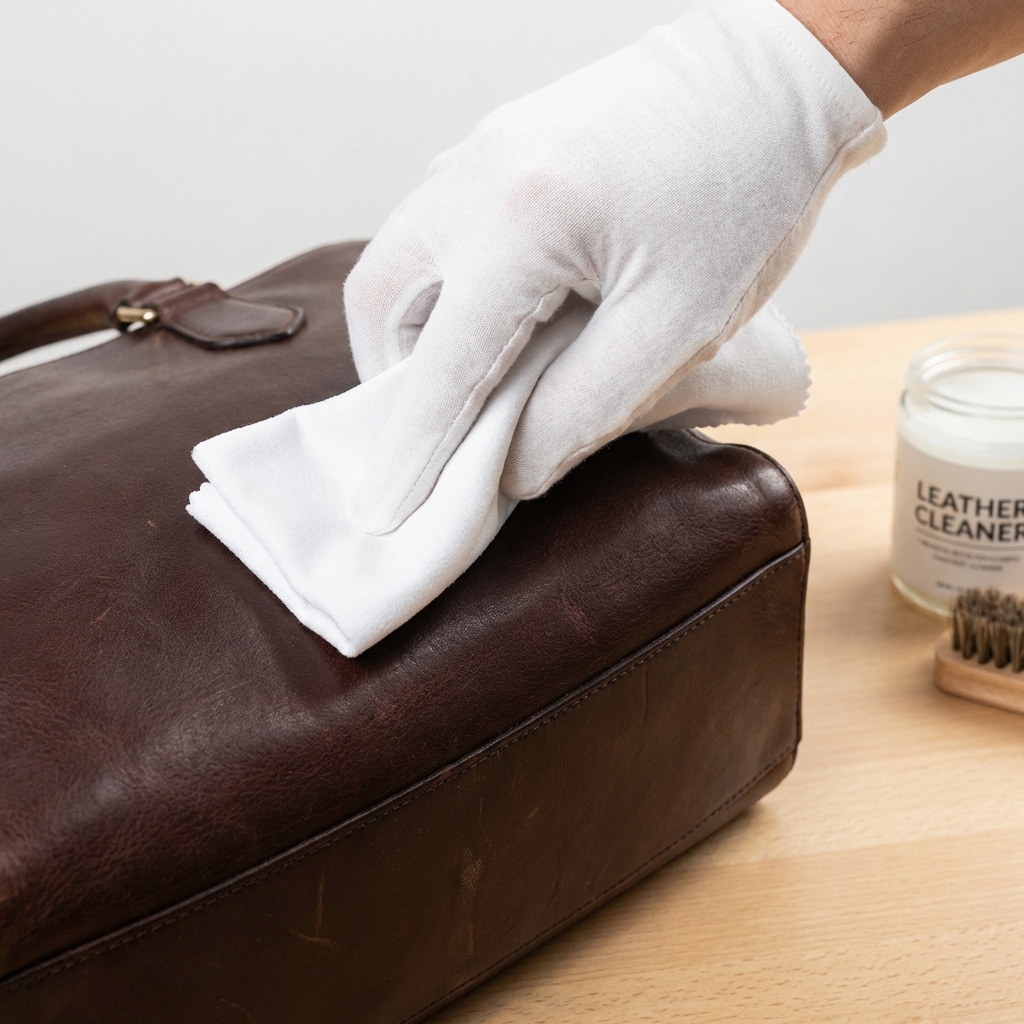
- A white microfiber cloth.
- Apply a dime-sized amount of foam/cream to the cloth, not the bag.
- Massage it into the cloth.
- Gently dab the stained area. Do not swipe across; dab to lift.
- Check the cloth. Is there blue dye? If yes, continue gently. If no, stop.
- Wipe away residue with a clean, damp cloth.
Method 2: The Makeup Remover Hack (Desperate Measures)
Only for Lambskin. Never Patent.
If you have no leather cleaner, a dye-free, oil-free micellar water (like Bioderma) can
sometimes lift fresh dye. Use a cotton pad, soak slightly, and blot. The micelles attract the
oil-based dye. Follow immediately with a leather conditioner, as this dries out the hide.
5. Advanced Restoration (The "Danger" Zone)
These methods are more aggressive. We generally recommend professional help over these, but if you are determined to fix it yourself, here is the truth about them.
The Magic Eraser Controversy
The "Mr. Clean Magic Eraser" (Melamine Sponge) is essentially ultra-fine sandpaper. It works by
sanding off the top layer of the leather containing the stain.
Can it work? Yes, on white/light lambskin.
The Risk: You are removing the protective topcoat. The area will become matte,
dull, and prone to future staining. If you use this, you MUST apply a heavy leather cream afterwards
to rehydrate the sanded area.
Solvent-Based Removers (Saphir Renomat)
Strong solvents like Saphir Renomat strip everything—dirt, silicone, wax, and yes, dye transfer. They also strip the original paint of the bag. Use this only if you are prepared to see the beige leather turn white/grey as the pigment comes off. This is a pre-step for professionals who plan to repaint the bag.
6. The Professional Repair Process
When you send a color-transferred Dior to The Leather Restorators, we don't just "clean" it. That usually isn't enough. Our protocol is restoration.
Step 1: Chemical Extraction
We use salon-grade extraction agents that dissolve the denim dye molecules. This usually removes 60-80% of the shadow.
Step 2: Color Matching
For the remaining stain, we do not scrub. We match the original Dior color (e.g., Rose Poudre, Latte, Grey Stone) using our archival pigment database.
Step 3: Micro-Pigmentation
Using an airbrush with a 0.2mm nozzle, we apply micro-layers of pigment over the stained area. This covers the stain completely while keeping the leather thin and natural. We do not "paint" the bag thick; we mist it.
Step 4: Topcoat Sealing
We apply a fluorocarbon resin topcoat (matte or gloss, depending on the bag) to seal the pigment and protect against future transfer.
7. Prevention: The Invisible Shield for Your Dior
Once your bag is restored, you must protect it. At The Leather Restorators, we believe prevention is the only 100% cure for color transfer. Here is how the world's top collectors preserve their pieces:
- The "White Tissue Test": Before wearing a new pair of jeans with a light-colored bag, rub a white tissue (damp with warm water) vigorously against the denim. If even a hint of blue or black appears, that denim is not "bag-safe."
- Mechanical Barriers: Wear a long trench coat, blazer, or cardigan that physically sits between your bag and your clothes. This simple layer prevents the friction that drives dye migration.
- Nano-Protective Coatings: We recommend applying a high-grade fluorocarbon-based protector (like Collonil Carbon Pro) every 4-6 weeks. It creates a molecular net that prevents dye from reaching the leather fibers.
- Professional Ceramic Guard: Much like high-end car detailing, we offer a specialized ceramic coating for leather that bonds at a microscopic level, making the surface hydrophobic and significantly more resistant to dye absorption.
8. The Science: Why Certain Dior Materials are Dye Magnets
To understand how to save your bag, you must understand its DNA. Dior’s Cannage Lambskin is semi-aniline, meaning it is dyed in a vat and finished with a very thin, breathable layer of pigment. This is what gives it that "second-skin" feel, but it also means the leather’s microscopic pores are wide open. When friction creates heat, these pores expand and "inhale" the dye molecules from your clothes.
In contrast, Dior Patent (Vernis) is non-porous. However, the dye doesn't just sit on the surface; it undergoes polymer absorption. The dye molecules dissolve into the urethane coating itself. This is why you cannot clean it—the stain is literally inside the plastic. Most owners realize this too late and ruin the gloss by trying to scrub a stain that is beneath the surface.
9. Advanced Restoration: The Atelier Protocol
When a DIY fix is impossible, our master technicians follow a medical-grade protocol to restore the bag's soul:
- Micro-Solvent Extraction: We apply polar solvents that specifically target indigo and black denim dyes while remaining "inert" to the leather’s essential collagen fibers.
- pH-Balance Re-alignment: Cleaning often strips the leather of its acidic pH. We bath the area in nutrient-rich creams to prevent future cracking or stiffness.
- Spectrophotometer Matching: We use digital color-matching technology to replicate the original factory batch color of your Lady Dior, ensuring any needed re-pigmentation is invisible to the human eye.
FAQ: Deep Care Insights for Dior Owners
Can dry cleaners remove dye transfer from bags?
Will Dior fix color transfer in the boutique?
Is there a difference between Indigo and Black denim transfer?
Can I use a Magic Eraser on my Dior Oblique Canvas?
Why is Patent Leather so hard to fix?
How much does professional dye removal cost?
Is your Lady Dior stained?
Don't risk permanent damage with home remedies. Get a free consultation from India's leading luxury leather experts.
Get a Quote via WhatsAppUpload a photo of the stain for an instant assessment.